Too late a post but probably just in time for the next Tropical Blaze Festival happening this February 27 and 28. Wrote this a few months back but didn't get the chance to post//

Earth. Water. Wind. Fire.
These are the elements that are essential in ceramics. Making pottery doesn’t stop after the shape is molded by the hands. It has to be fired at a high temperature in order to hold its form. Without the intense heat, clay remains impermanent and is bound to break again into mud. The Tropical Blaze Wood-firing Festival is a celebration of this gift of fire. It is a series of events initiated by the College of Fine Arts of the University of the Philippines, in partnership with local potter Pablo Capatti III, which focuses on understanding the different traditional and alternative methods of firing.  


 October 20, 2014. Diliman, Quezon City.

Clay pieces in the shape of unusual seeds were buried in sawdust, colorants, straw and shredded newspaper inside a pit. Firewood, kindling, newspapers and straw were placed next and was set ablaze like a huge campfire. The hearth was carefully tended for a while and was left to burn the  combustible materials. 


By afternoon, the firing of LUAL started. LUAL is a sculptural kiln in the form of a birthing woman built by Prof. GudiƱo. The second firing started with a ritual. Wood, flowers, salt, rice, and wine were given as offertory along with prayers and songs. 


Lual. Works from Ma'am Rita and Sir To Austria's class were fired inside the kiln.


 Local potters, teachers, and students participated in firing Lual, which lasted until before dawn of the following day. Films, music, and good food kept us company as we waited for the ceramic pieces to come out of the birthing mother. 


October 24-25, 2014. Capati Farm, San Jose, Brgy. Pinagtungulan, Batangas.


Students from the Ceramic Classes in UP arrived at Pablo Capati’s farm at around two in the afternoon. By the time we got settled, we were introduced to Pablo’s other guests. There were local potters and potters from Thailand.


Familiar faces: Kuya Benjie and Sir Pete beside the Anagama


Bathma Kaew-Ngok, a Thai potter who apprenticed in Japan, gave a demo on glazing tumblers in Igayaki using wood ash


We were all given the opportunity to glaze one piece. Hurray!


Mick and Sir Nick placing the glazed works inside the gas kiln


Sir Nick and Sir Joey loading the kiln

Afterwards, Bathma and the other Thai potters gave a demo on the wheel


 We were also taught the proper way to stoke the Anagama. The Anagama Kiln is a type of Japanese tunnel kiln. It is fired for two to three consecutive days to produce natural wood ash that settles on the works and became its glaze!


Stoking with Kuya Benjie

By nighttime, we headed to the guesthouse for dinner and for the artists’ presentation. Seeing the works of other potters made me realize the different possibilities that can be achieved with clay, that it is not limited to the creation of functional ware. The night was capped with the designation of firing schedules, where each student was assigned to attend to the kiln for two hours. Spent the night talking to other potters about their passion with clay, and to just watched the allure of red fire burning the wood.


Some of the students camped out during the night.


By morning, while most were still sleeping, we tried our hands on the wheel


Sir Pete doing a demo


By late, the others started coming in and made their own works as well. This lasted throughout the day with all of us in the zone, each creating unique pieces from flowers to corals and organic shapes. Btw, this is Koh, one of the Thai potters doing a handbuilding demo


With Ciara, my MFA classmate. Hi!


Ma'am Rita doing a sculptural piece and Sir To kneading clay


Mick doing a demo on how to make a drip coffee cup


Our works being dried


My work 


The Anagama Kiln! Fire up the chimney


 The fired pieces from last night's firing survived!


The day ended with Pablo giving out tumblers from the pieces we glazed the other day, and it was a surprise for us that the pieces from Bathma and Sir Joey were also handed out in a draw! Everyone went home happy and filled with gratitude for the invaluable experience and lessons that had been shared to us. Truly, fire has the capacity to transform not only clay, but people as well.

Special thanks for the demonstrations, workshops and talks from the local potters, Pablo Capati III, Joey de Castro, Pete Cortes, Benjie Ranada, Yohan; to the Thai potters, Bathma Kaew-Ngok, Prof. Sekporn “Nick” Tansripraparsiri, Natthapol “Mick” Wannaporn, Watchara “Koh” Siresevakul and to the UPCFA Ceramic Department, Prof. Rita Gudino.

Til the next Tropical Blaze!

Read more...


And so, school happened but it was a different feel than before. 
I was completely unaware of what I signed up for. Haha.
 I don't think it solved personal issues I want to address but it did me well on other aspects of my life.

Here are some of the ceramic works I did.


My theme revolved mostly around the temporal nature of things and how they are bound to transform and decay over time. I've been contemplating a lot on this topic recently.


I am particularly fond of the broken and forgotten.


And the fragile nature of things.


I forgot to tell that I recently acquired a secondhand kiln and I'm still on an experimental stage. 
My first glaze test didn't work that well so I'm back to more trial and error.
(Reason why most of the photos here are bisque fired)


Really excited with all the science involved in making pots!
I hope things work well in the future.


Read more...


I. The Pit Fire
She watches quietly as the fire burns in the nighttime. The flame dances with the wind and rises up, up, up as if trying to reach its distant relatives in the sky. It shines bright red in contrast to the dark of the night, seducing the spectator into the dancing shadows. Of course, she is familiar with the prickly heat once at contact with the flame, but it didn't stop her from moving close. In each stoke of wood, the flame demanded to be felt through the tiniest pores of the human skin. The wood is unforgivingly sacrificed to the flame. It fuels the fire, sustaining its energy for dance. The wood crackles, perhaps laughing at the circumstance. It knows it is time to serve its purpose. Soon, it will disintegrate into ashes and in ashes it will give life to clay. The clay stands unmoved at the bottom of the hearth, enveloped in layers of sawdust and paper that will also turn to ashes like its brother. Nothing really escapes the fire, is there? The clay too, is touched by the flames and undergoes its own transformation. Its dull grayness is changed into peach orange - almost like the color of flesh. It is given life. How fascinating is this capacity of fire to destroy and create! She watches quietly as the fire burns in the nighttime. The flame dances with the wind and rises up in the sky.

II. Lual

Flowers, wood, rice, salt and wine. These were the offerings to the birthing Goddess, Lual. The spectators anxiously waited for the coming of the children. The air is filled with songs and prayer as the mother breathed in...then breathed out. It is a rhythm that went on for long hours. Hot flashes rose up from her head like a volcano ready to erupt. The anticipation is killing! When the time was ripe, the surgeons took the babies out of the mother's womb every hour. Yes, every single hour. Excitement overcame the crowd at first glance of the newly-born. The littlest things were radiating with red, the heat absorbed in their flesh and bones, they are alive! Guests showered them with paper and sawdust and a little water, as if saying, "Welcome to the world, our precious one!" What joy there was to witness the gift of life? There were tears shed, smiles shared, hearts exchanged. The sun finally greets and says congratulations to everyone for a job well done. 

III. Anagama

 He fed the beast with wood. The fire escaped from its mouth and the heat is absorbed by the skin. Such warmth is good on a cold night at the foot of the mountain. It is also past midnight, he noticed, but the energy is still very much alive like the blazing fire. From the background, he could hear young people singing -dancing even - while at the side were the conversations of older men. It must be the alcohol, he thought, that keeps the energy going. He has come to this potter's house like the other visitors to witness the Anagama but he is given much much more. He has been especially thankful for the company, the wisdom exchanged and that communal experience with the earth. They have transformed clay to all sorts of things - from bowls, to cups, to sculptural forms. Interesting, he exclaims, how such a simple pot can be created differently from what he was taught. He noticed the gestures of the hand, the speed of the wheel, the inclination of the body, the intuition! What inspiration! Everything seems new again. 

He took his mug of beer and sat by the Anagama. The beast is awake, bursting red hot fire from its holes. He can see the flames circling around the stomach of the dragon, devouring the wood and embracing the pots inside. It is only 900 degrees. It will probably take one more day before it reaches its maximum temperature, he thought. For now, he can just watch and spend time exchanging stories with newfound friends.


Notes. Wrote this while I was still at a hype from the Tropical Blaze Wood Firing Festival at UP CFA. Sorry for romanticizing the article I'll post a more structured article (with pictures) soon. 

Notes II. Pit Fire Lual and Anagama are different types of firing ceramics. Pit Firing as its name suggests is done by digging a hole in the ground. It is one of the primitive methods of firing. Lual is a sculptural Raku kiln designed by Asst. Prof. Rita Badilla-Gudino. Anagama is a big kiln that is usually fired for three days. All of these kilns are fired by wood.

Notes III. Special thanks to Ma'am Rita and Pablo Capati III for making this happen. Also thank you to the Thai potters, and the local potters for their assistance.

Read more...


Will be posting my past travels every now and then in no chronological order. I'm really excited to share most of the places I've been to for the last few months. Manila's summer heat is getting under my skin and it makes me miss the cold of AZ. I fairly miss visiting the ceramics studios in Arizona and wished I got to spend more time with the potters there. Their works are awesome!

First stop is ASU Graduate Ceramics Studio


Kelly O'Briant doing a demo on spoons!


I love how simple and elegant her works are.


Jonah Amadeus


Shiyuan Xu. I fell in love with her works the moment I saw it. 
Her works are so fragile and complex! 


She is also helpful in answering my questions and in sharing her technique.
For the record, I tried making one for myself because I can't get it out of my head.
This piece is infectious and beautiful.


More works


Jonathan Cross


Takashi Hara


Kazuma Sambe. His works traces back to his Japanese roots. I also like the use of underglazes. 


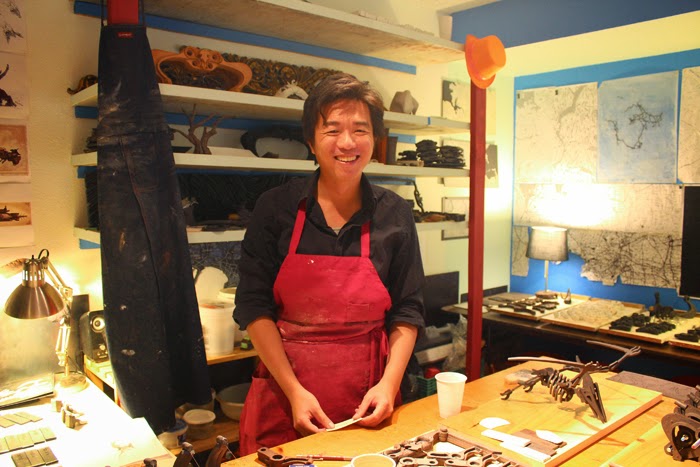
Wen-dan Lin. I envy his studio space! And also his works. 
He can take my money if I had enough money to buy his stuff!


This is ceramics! He handbuilds each mechanical piece. 
Have I told you that you can move the parts and it makes sounds. Awesome.
(That pterodactyl in the background is also made of ceramics!)

Second stop is at the ASU Art Museum


MUCK Exhibit showing works by Susan Beiner, Nathan Craven, Michael Fujita, David Hicks, Annabeth Rosen, Meghan Symthe and Matt Wedel.


My favorite piece by Matt Wedel


At the Museum store


Work by Tiffany Bailey


More from different artists at the store. It's cool how they dedicate a shelf for ceramics

 Third stop at the studio of Sandy Blain in Tempe, AZ.


From other artists.


And Last stop at Farraday Newsome's home in Mesa!


More Tiffany Bailey


I love seeing other people's workplaces


Jeff Reich 


Jesse Armstrong


Good, good work!

Also sharing Desert Dragon Pottery Studio
They fired my works during my stay and are awesome people as well!


It is a different feeling to see their work in pictures than in seeing and touching it in real life. And it's an ever greater experience catching them doing their work! 
I just want to say thank you to all the potters I met and how incredibly generous of them to share their knowledge in ceramics! For someone like me who hasn't seen a lot of pots in my life yet, this is one great experience I'll forever be grateful for. 

END
Read more...